AI Foundry Overview
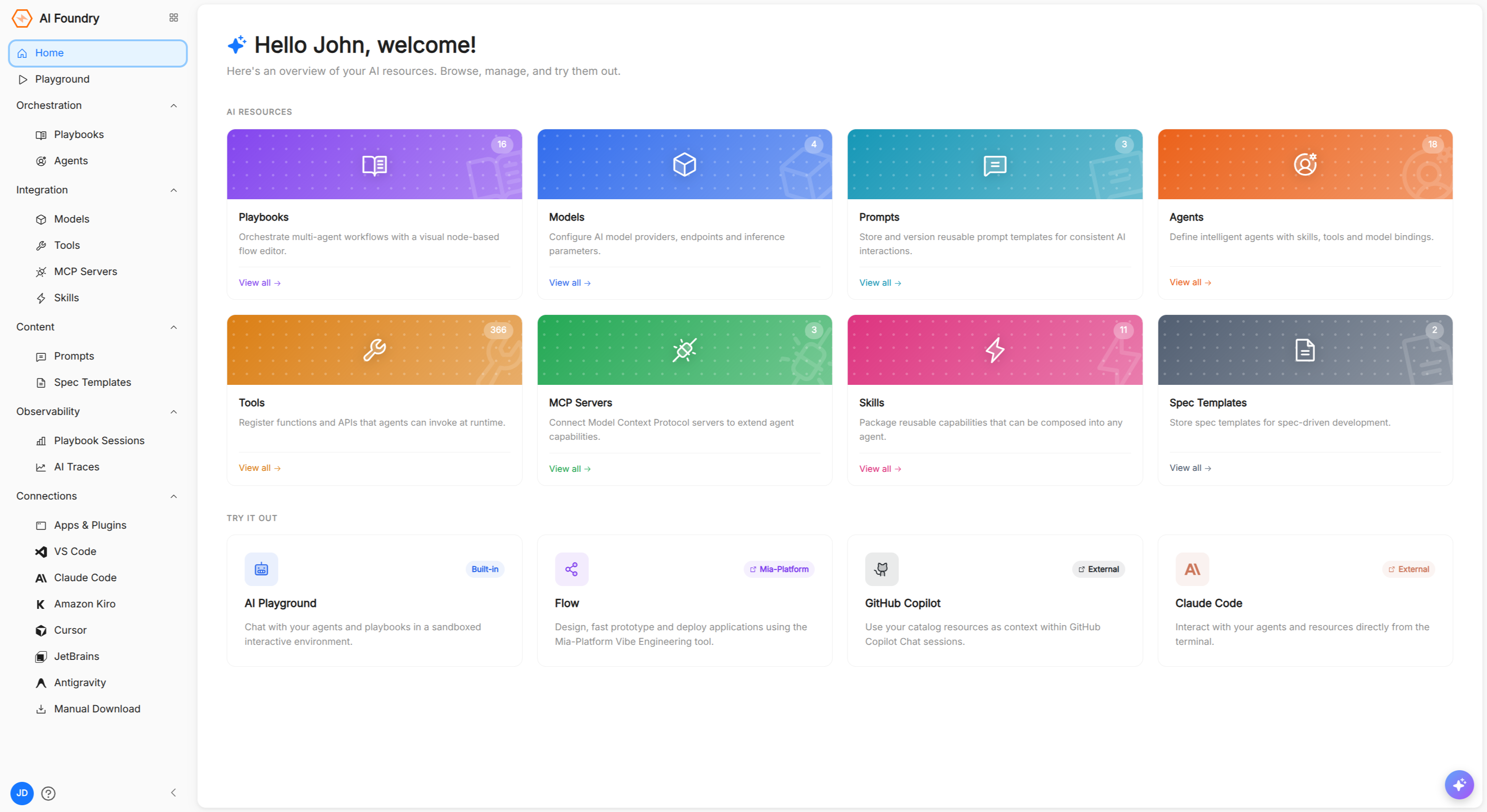
AI Foundry is a web-based management and orchestration platform for building, managing, and validating AI-powered workflows. It provides a unified interface to compose and test complex agentic applications without writing code directly, targeting enterprises that need to govern and reuse AI assets across teams.
Key Concepts
AI Foundry organizes AI assets as catalog resources, each sharing common metadata (name, title, description, tags, labels, and timestamps). The platform manages eight resource types:
| Resource | Purpose |
|---|---|
| Agent | An AI entity backed by a configured LLM, with assigned tools, skills, and system instructions. |
| Model | An LLM configuration that wraps a model identifier and its runtime parameters. |
| Prompt | A reusable prompt template that agents and playbooks can reference. |
| Tool | An executable function or integration that an agent can invoke, including tools exposed by MCP servers. |
| Skill | A reusable capability that agents can call. |
| Playbook | A multi-step agentic workflow composed of agents, prompts, skills, and specs connected in a directed graph. |
| MCP Server | A Model Context Protocol server that exposes tools and resources to agents. |
| Spec Templates | A free-form specification document referenced by playbooks and workflows. |
Features
AI Playground
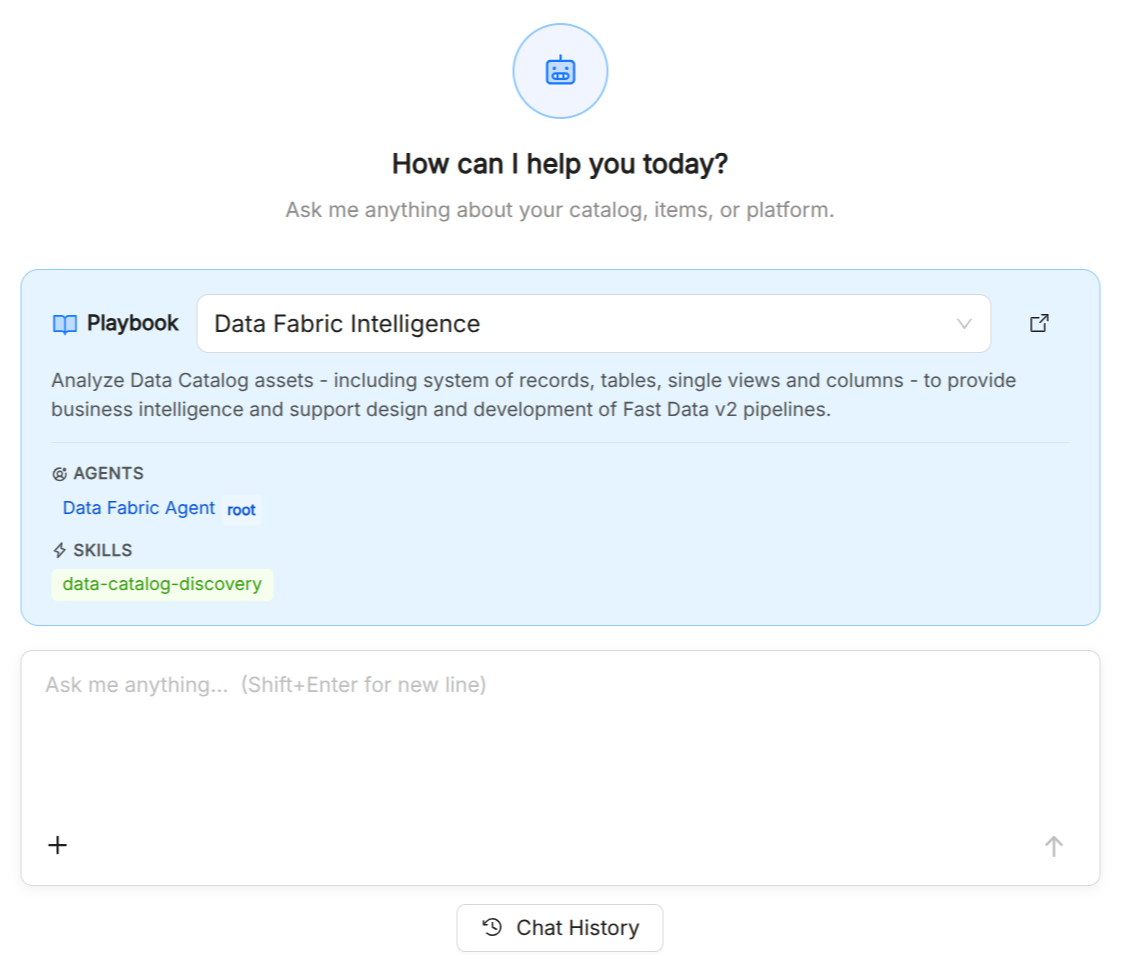
The AI Playground provides a live chat interface for testing agents in real time. Select a playbook, configure per-agent model overrides, and chat with the configured agentic flow. The playground streams responses, visualizes tool calls and "thinking" steps inline, and lets you enable or disable individual tools and skills on the fly. It also supports slash-prompt auto-completion from prompts associated to the selected playbook.
Observability
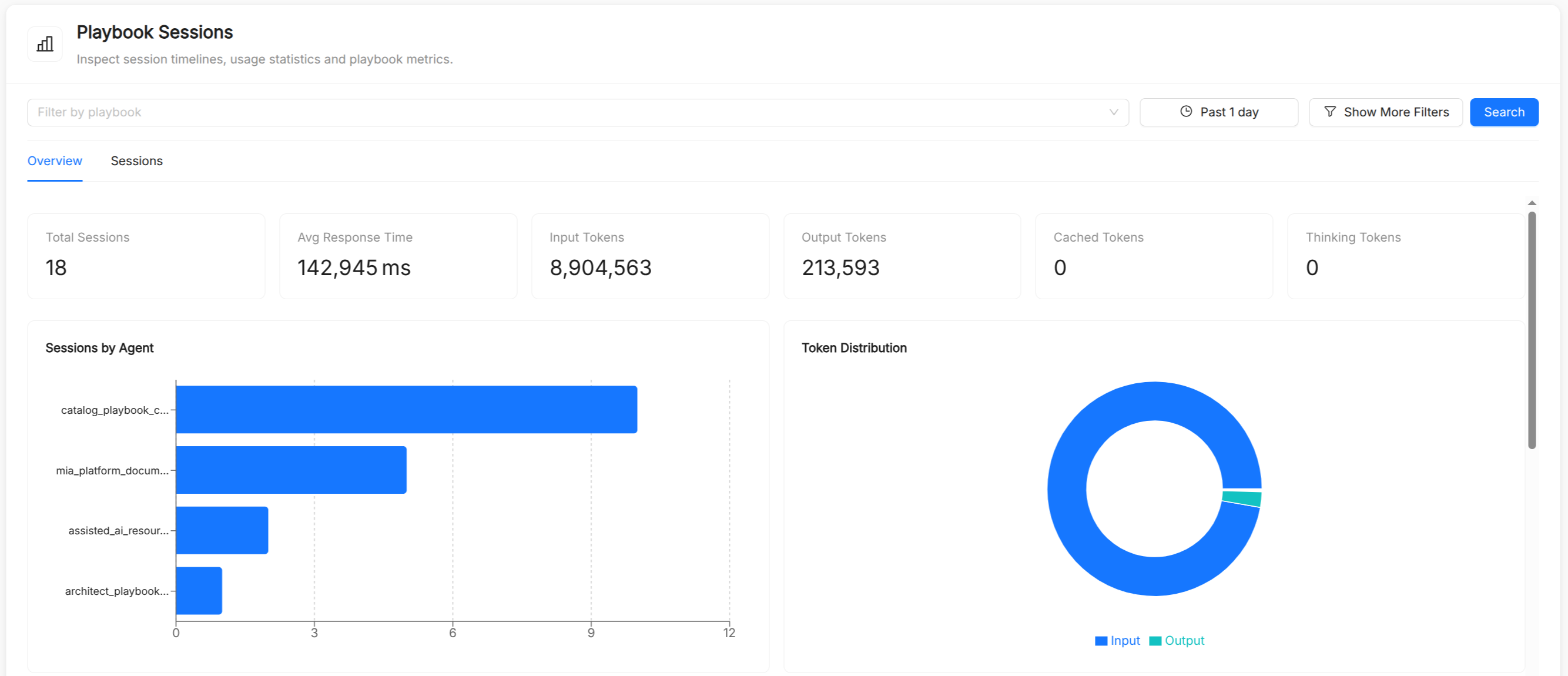
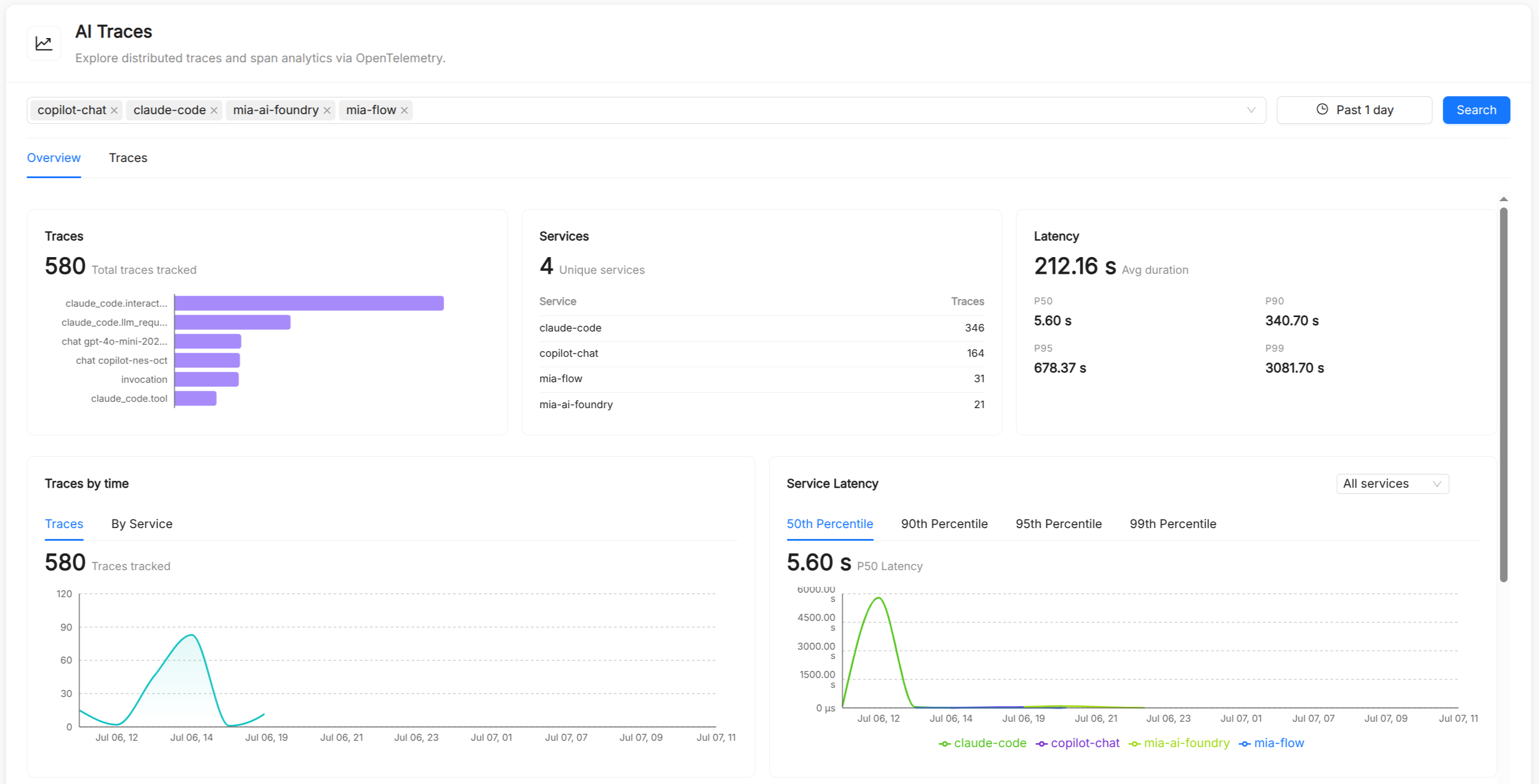
Monitor how your agents and playbooks behave in production from two dedicated pages. Playbook Sessions surfaces aggregate usage statistics, charts, and a searchable log of individual sessions, with a full event timeline for each one. AI Traces complements it with lower-level distributed tracing across AI Foundry's own services, for diagnosing latency and errors at the span level. See Playbook Sessions and AI Traces for details.
Playbook Builder
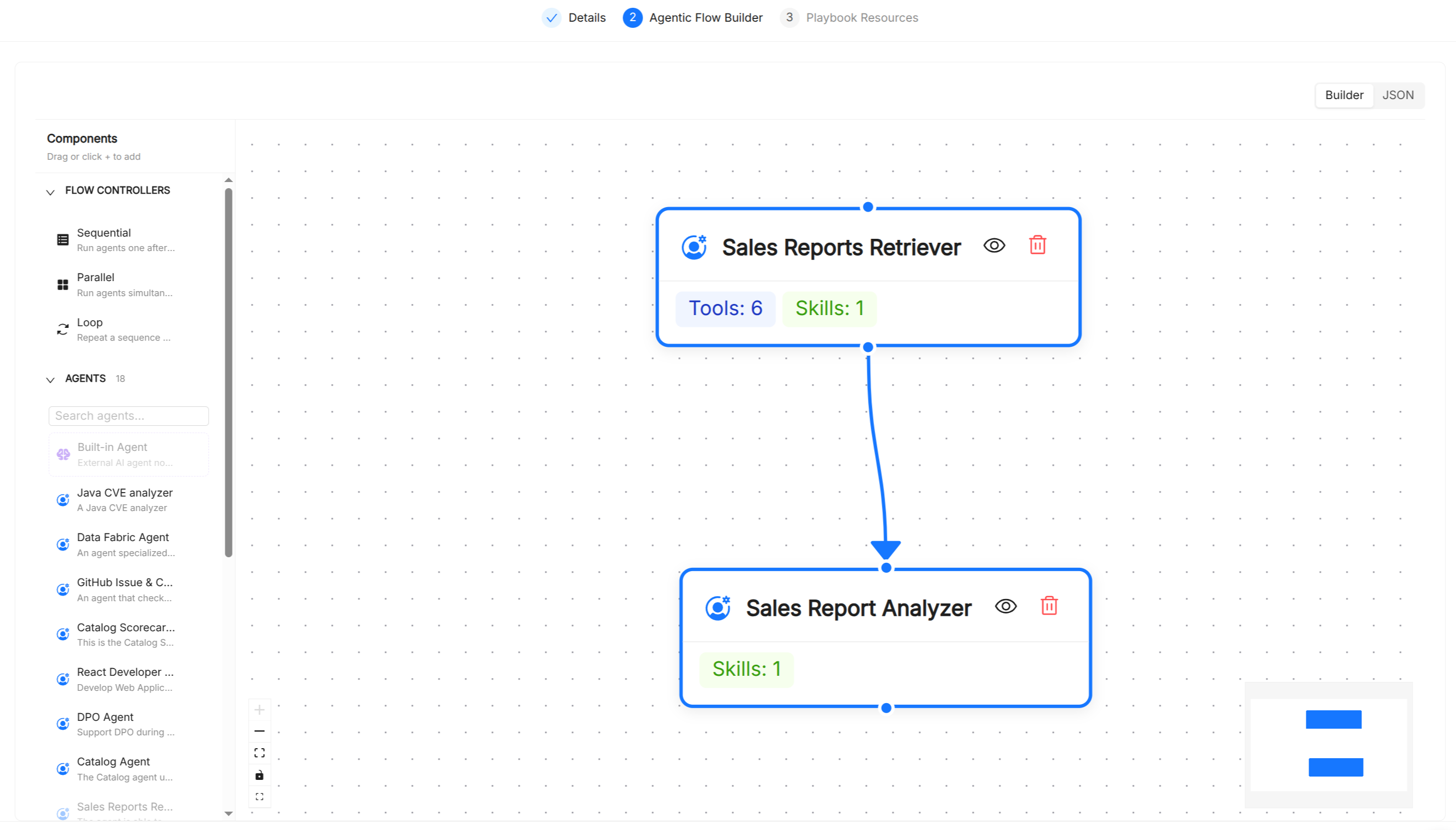
The Playbook Builder is a three-step wizard for designing multi-step agentic workflows:
- Overview: set the playbook's name, title, and description, and optionally enable and configure its Mia Flow integration (show-on-home toggle, launch mode).
- Agentic Flow: a drag-and-drop canvas where agent nodes are connected with edges. In addition to regular agent nodes, you can add orchestration nodes for sequential, parallel, and loop (with configurable max iterations) execution patterns.
- Resources: attach playbook-level prompts, skills, and spec templates using multi-select pickers.
Playbooks can also be authored as raw JSON using the built-in Monaco editor.
Agent Management
Create and configure agents by selecting an LLM model, writing system instructions in Markdown, and attaching tools and skills. Tools are shown grouped by category in the picker, including tools sourced from registered MCP servers. Agents can be created through a guided form or by editing the underlying JSON spec directly.
Model and Prompt Management
Manage LLM configurations and prompt templates as first-class catalog items. Prompts are authored in Markdown with a live preview pane and can be tagged for discoverability.
Tool and Skill Discovery
Browse all tools and skills available in the system, including those exposed dynamically by registered MCP servers. Tools and skills are attachable to agents from the catalog.
MCP Server Integration
Register external Model Context Protocol servers to expand the tool ecosystem available to your agents. Each registered server is stored as a catalog resource and its tools are included in the available tools list.
Programmatic access
The AI Foundry ADK BE APIs can be called machine-to-machine using a service account, registered through Platform Administration — see Registering a service account and Requesting an access token. Unlike Catalog, calling the AI Foundry ADK BE APIs requires the token to be requested with all three scopes together — mia:catalog, mia:ai-foundry, and mia:authz — requesting mia:ai-foundry alone is not sufficient.
The agents and playbooks you author in AI Foundry are executed by the agent runtime (adk-be-app), the agentic engine underneath the whole suite. You can install it on its own to use your agents from applications and systems that are not provided by Mia-Platform, calling its ADK APIs while the configuration stays in the Catalog. The runtime reads that configuration with its own service account, which needs only the mia:catalog scope. See Runtime installation to install it and connect it to your Catalog.
IDE and tooling integration
You can download the following AI assets to work from your workstation:
These exports let developers work seamlessly from the cloud or locally.
AI Foundry also provides a dedicated Connections area in the left sidebar, with setup guidance for specific IDEs and tools (VS Code, Claude Code, Cursor, JetBrains, and others), plus a generic manual-download option. This lets developers wire their editor's plugin or marketplace mechanism directly to their AI Foundry catalog, rather than downloading assets one at a time.
Where to go next
New to AI Foundry? Start with the Basic Concepts section:
- Agent: the autonomous AI actor at the heart of the platform.
- Model: LLM configurations that back agents.
- Prompt: reusable text templates for agents and workflows.
- Tool: executable functions agents can call.
- App: applications and plugins that built-in tools belong to.
- Skill: reusable, higher-level AI capabilities.
- Playbook: multi-step agentic workflows.
- MCP Server: Model Context Protocol server integrations.
- Spec Templates: structured reference documents for agents and playbooks.
- Runtime installation: install the agent runtime and connect it to the Catalog.
- Playbook Sessions: session-level monitoring and analytics for playbook and agent runs.
- AI Traces: distributed tracing across AI Foundry services.