Playbook
A Playbook is a catalog resource that describes a multi-step agentic workflow. It composes agents, prompts, skills, and spec templates into a directed graph where each node performs a discrete task and edges define the flow of control and data between them.
Playbooks move the AI platform from single-agent interactions toward agentic pipelines: complex, stateful workflows where the output of one agent feeds the input of the next, loops repeat until a condition is met, and parallel branches execute concurrently.
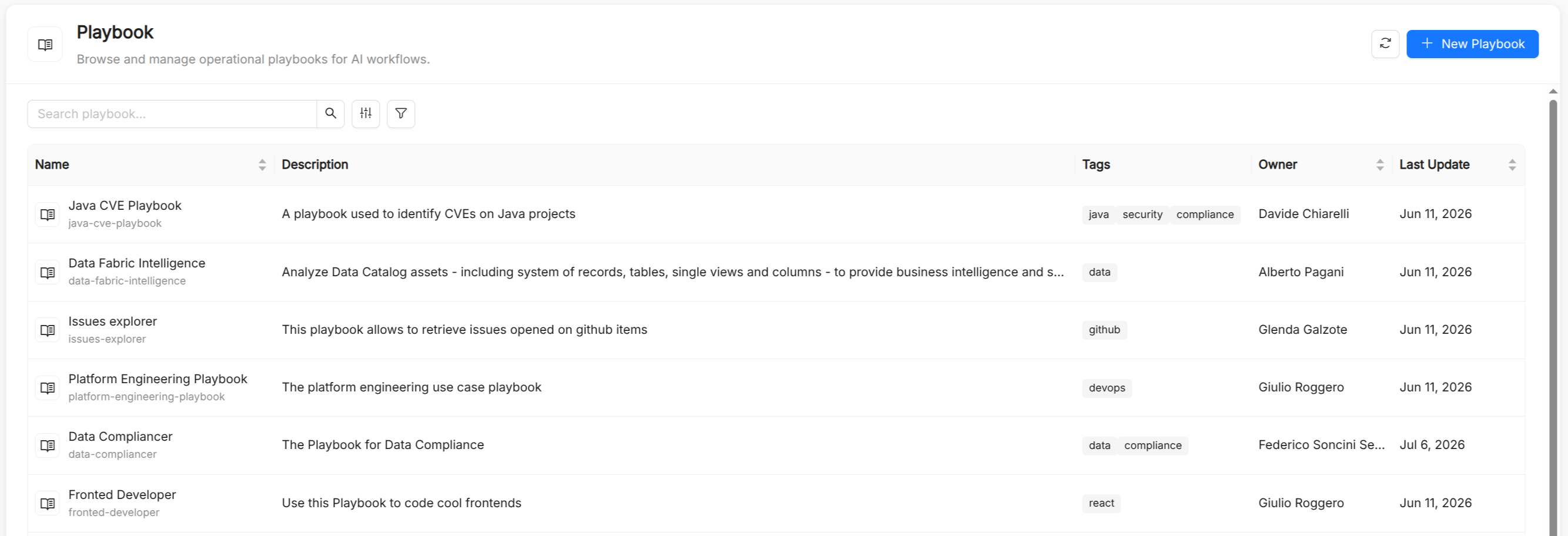
Playbook reference
| Field | Required | Description |
|---|---|---|
Title | Yes | Display name shown in the UI. |
Name | Yes | Unique identifier, auto-derived from Title. Lowercase letters, digits, dots, and hyphens only (must start and end with an alphanumeric character), max 63 characters. Immutable after creation. |
Description | Yes | Short description of the workflow's purpose. |
Tags | No | Free-form, multi-value tags used to make the playbook easier to find and filter. |
Prompts | No | Playbook-level prompts injected into every agent node in the flow. |
Skills | No | Skills available to all agents in this playbook. |
Spec Templates | No | Spec templates available to all agents in this playbook. |
Built-in Agents (reference) | No | Read-only summary of built-in agent nodes (external AI agents not managed by the Catalog) placed in the Agentic Flow. Managed from the flow canvas, not from this list. |
Mia Flow integration
A playbook can optionally be exposed in Mia Flow. This is configured in the Overview step's Configuration section:
| Field | Required | Description |
|---|---|---|
Enable on Mia Flow | No | Master switch. When off, none of the fields below apply and the playbook is not exposed in Mia Flow. |
Show on Home | No | Shown only when Enable on Mia Flow is on. When enabled, this playbook appears as a quick-launch button on the Mia Flow home screen. |
Launch Mode | Yes, when Mia Flow is enabled | Shown only when Enable on Mia Flow is on. Default UI to open when this playbook is launched from Mia Flow: Chat, Code, or Both. |
Playbook flow model
A Playbook workflow at its core comprises a set of orchestrated agents working sequentially, in parallel or loop.
You can either deploy a single built-in agent (an external AI agent not managed by the Catalog, like a model provider or third-party assistant) or a combination of agents managed by the Catalog.
The visual builder
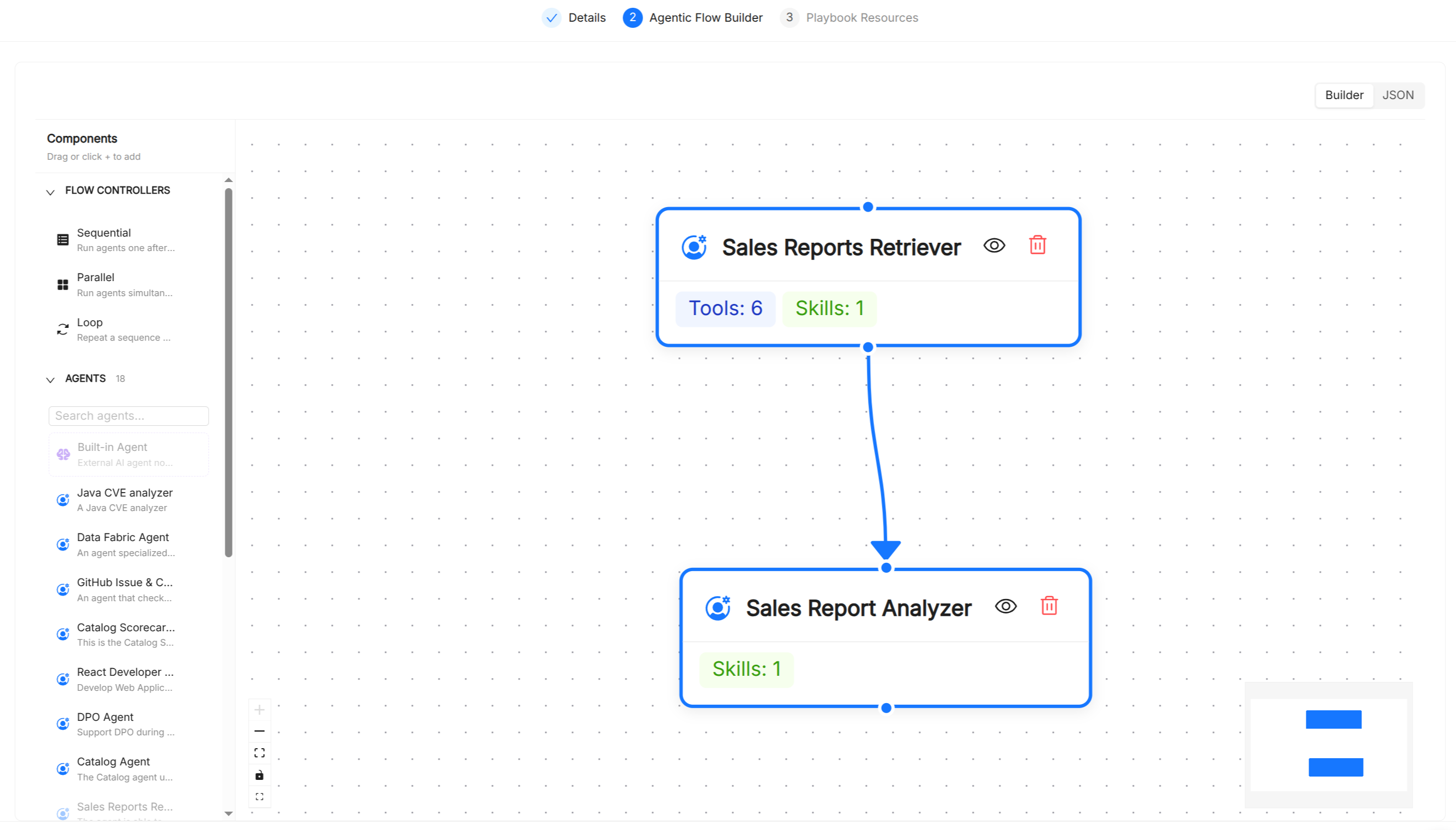
The Playbook Builder in the AI Foundry UI provides a drag-and-drop canvas for designing and editing without writing JSON:
- Overview step: set name, title, and description.
- Agentic Flow step: add nodes from a palette, draw edges between them, and configure node properties.
- Resources step: attach playbook-level prompts, skills, and specs using multi-select pickers.
Switching to JSON mode replaces the visual builder with a full-spec JSON editor, which is useful for bulk edits or for copying playbooks across environments.
Resource scoping
Resources (prompts, skills, specs) can be attached at two levels:
- Playbook level: available to every node in the flow.
- Node level: available only to that specific node. Node-level lists are merged with the playbook-level lists.
This allows a common baseline (e.g. a shared style guide) while letting individual nodes use specialized resources.
See also
- Agent: the execution unit referenced by playbook nodes.
- Prompt: reusable text injected into nodes.
- Skill: reusable capabilities attached at playbook or node level.
- Spec Templates: structured documents referenced by nodes.