History and Item Versioning
The Item Versioning feature in the Catalog lets you track changes to an item over time, compare revisions, browse its history, and roll back to a previous version.
User interface and history management
Selecting an item in the Catalog opens its detail view, which includes a History section with two tabs:
- All Revisions — a continuous log of every save and change made to the item, showing its timestamp, editor, and the version it's linked to (if any).
- Versions — the subset of revisions that have been promoted and saved under a dedicated name (e.g.
1.2.4), together with the author and, when provided, a description of that version.
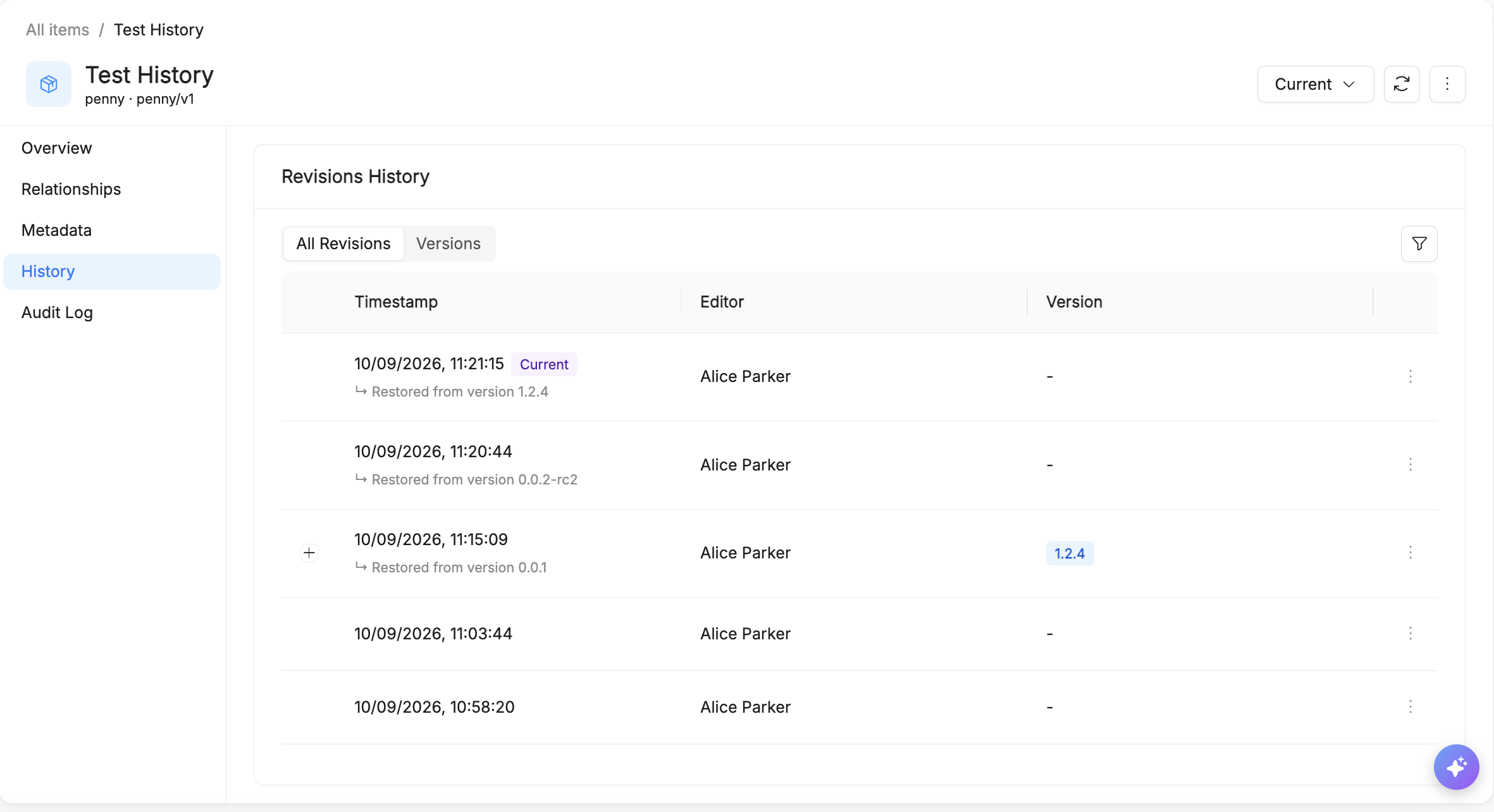
The banner at the top right — showing Current by default — lets you switch to viewing any past version or revision. While viewing a non-current state, a banner shows which version/revision you're looking at and its timestamp, with shortcuts to go Back to current or Restore that state directly.

Operations on versions
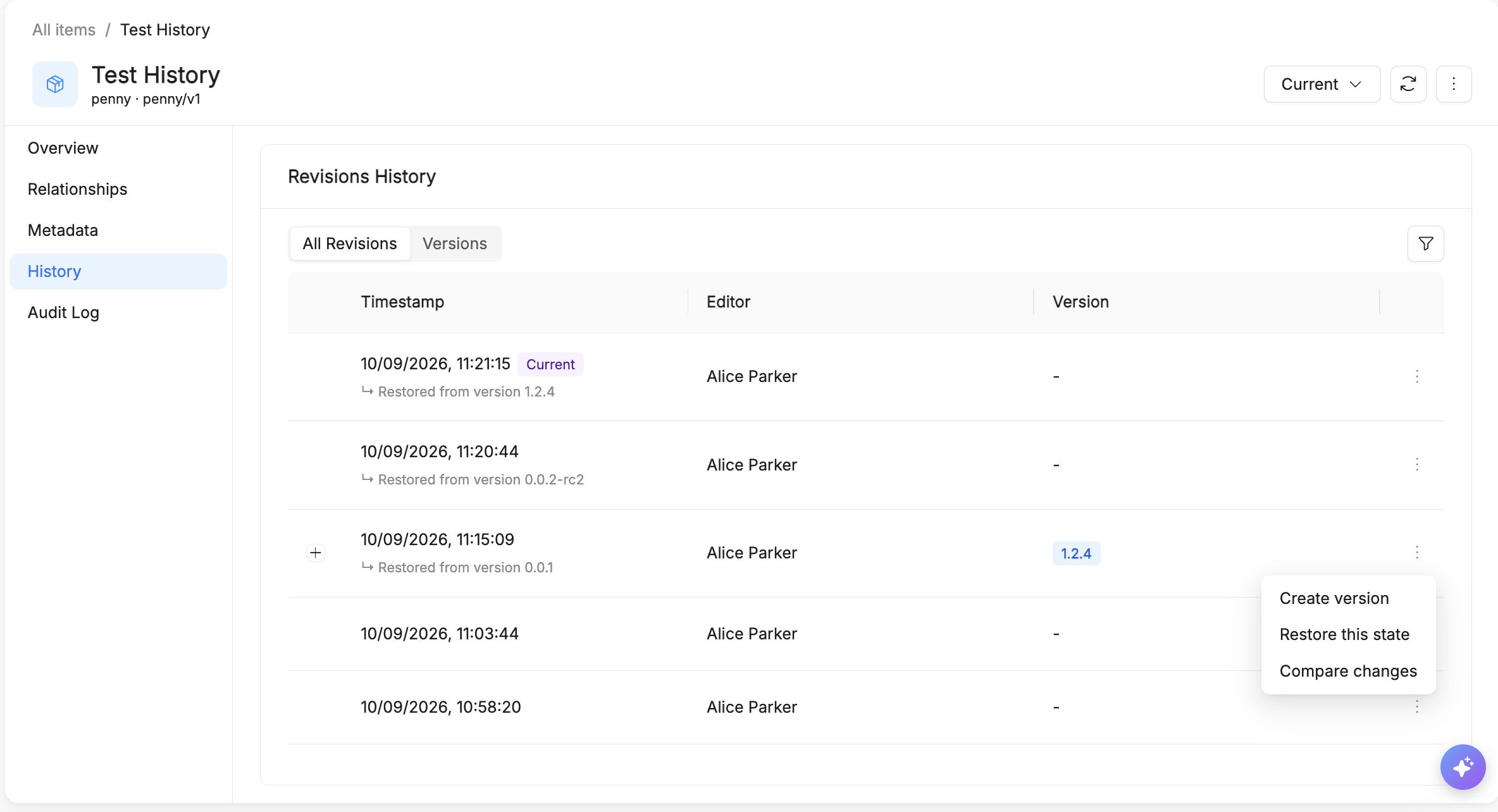
From the row actions menu (⋮) on an entry in All Revisions or Versions, the following actions are available:
- Create version — promote that revision to a named version.
- Restore this state — roll the item back to that revision or version.
- Compare changes — open a line-by-line diff against another state.
Configurability per Item Type
Versioning is configured on the Item Type itself, under Revisions History:
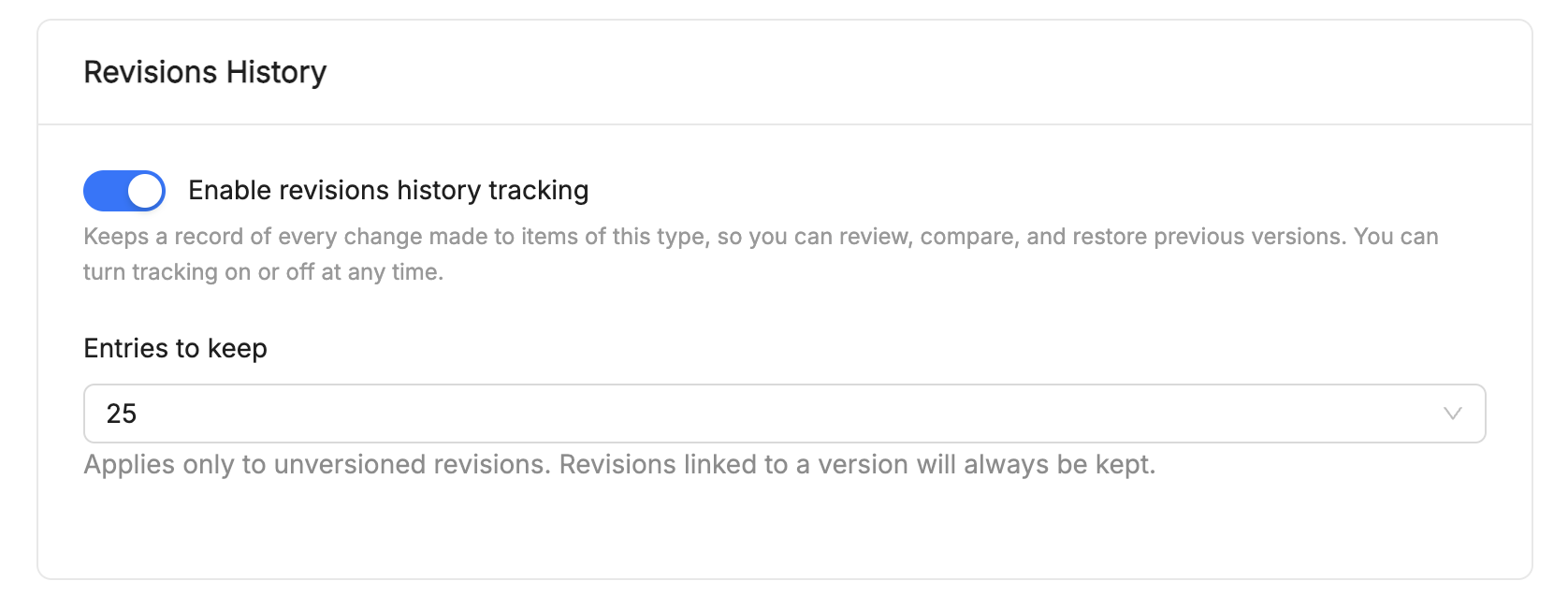
- Enable revisions history tracking — a toggle that turns tracking on or off for every item of that type. It keeps a record of every change, so it can be reviewed, compared, and restored, and it can be switched on or off at any time.
- Entries to keep — how many revisions to retain (e.g.
25). This limit applies only to unversioned revisions: any revision linked to a named version is always kept, regardless of this setting.
Creating a version
- The version name is mandatory: submitting the form with an empty name must block the action and show an error.
- Uniqueness: creating two versions with the same name (e.g.
1.0.0) should either be rejected or handled with a clear error message - Name format: it is unclear whether the name field validates a specific format (e.g. semver) or accepts free text — to be verified by trying non-semver strings (
abc, strings with spaces, special characters, emoji, very long strings). The observed examples (1.2.4,0.0.2-rc2, …) are semver-like, but this doesn't confirm the field enforces that format. - Description is optional: it should be possible to save a version without a description, as well as with a very long or Markdown-formatted description.
- Permissions: only a user with item editor role can "Create a version", or should get an error if they attempt the action.
Navigating between versions
- The version selector at the top lets you switch between Current and a specific version, and back; all tabs (Overview, Relationships, Metadata, History) must consistently reflect the state of the selected version.
- While "viewing version X", fields must be read-only (no accidental change should be savable).
- The "Back to current" banner must restore exactly the Current state, without side effects.
- Deep link/refresh: reloading the page while viewing a non-current version — to be verified whether the navigation state persists in the URL, or is lost (falling back to Current).
- With many versions, pagination/scrolling in the table and in the dropdown should be verified.
Comparing versions (Compare changes)
The Compare Changes dialog lets you pick a Reference state and a Compared state (each a specific version, revision, or Current) and shows the two JSON snapshots as a line-by-line diff, with changed lines highlighted.
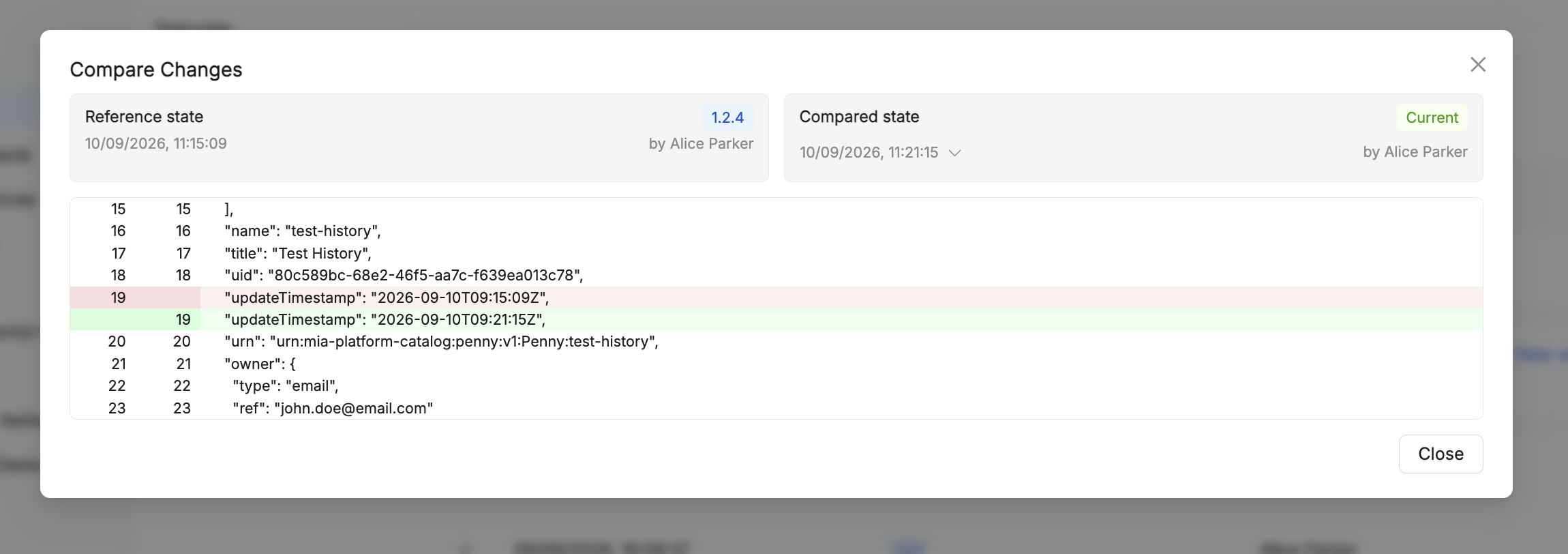
- Compare Current vs. a previous version, and two previous versions against each other.
- For an item with no real differences, the diff should show "no changes" rather than an error or a misleading empty diff.
- Compare versions with changes on relationships/metadata, not just the main content, to check whether the diff covers all sections or only some — the observed diff is a raw JSON line diff of the whole snapshot, so it likely covers everything serialized on the item, but this should be confirmed for relationships specifically.
- Fields added/removed between the two versions (not just modified) — the diff should flag them as add/remove rather than ignoring them.
Restore
- Restoring a previous version onto the current item should create a new entry in All Revisions (audit trail), rather than silently overwriting the history.
- Repeated restore of the same version must be idempotent and must not produce errors.
- Restoring while the item has relationships with other items (there is a dedicated "Relationships" tab) — relationships should be restored consistently, or flagged if broken.
Editing a version
- Editing only the name, only the description, or both, should only change the version's metadata, never the underlying content/snapshot.
- Renaming a version to a name already used by another version.
- It's not possible to delete a version